Patent Analysis: Patent File Wrappers as a Tool for Competitive Intelligence
What is a patent file wrapper? Why is a file wrapper an important source for gathering information to better understand technology, products, and markets? A step-by-step guide on how to review and find key information in a file wrapper.
INTRODUCTION:
Patents contain an incredible amount of valuable technical, legal, and market information*.
Patents have many uses, most Innovators file patents as they believe that the eventual issued patent will provide them with an exclusive right to make, use, or sell any products or services covered by the patent’s claims. This is a common misconception, in reality, the exclusive right of an issued patent entitles the owner to prevent anyone else from making, using, selling, or importing the claimed invention.
People use the information in patents for a variety of reasons. According to Dr. Bowman Heiden, Co-Founder of the Center of Intellectual Property in Gothenburg Sweden patents and have two main use cases:
- As a control mechanism to mitigate market risks (or seize market opportunities) associated with making, using, or selling products.
- To gather competitive intelligence on technology, products, and markets (it has been documented that much of the information published in patents is not available anywhere else).
Patent attorneys that draft and prosecute patent applications look at patents through a legal lens focusing on the legal and technical arguments which define the novel features of a patented invention.
R&D, corporate development, marketing, and investment analysts look at patents primarily as a means to gather competitive intelligence. Specifically, patent information provides insight into the who, what, when, where and how of technology, product development, and market trends. Analyzing the technology or patent landscape in context of other similar innovations provides a valuable way to gain unique insight into the R&D and business development activities of market competitors.
One aspect of the patent application process that often gets overlooked by non-patent attorneys are file wrappers, also known as file histories. A patent’s file wrapper documents all of the communication (between the patent applicant and the patent examiner) related to the process of applying for and the eventual allowance, rejection, or abandonment of a patent application.
File wrappers provide details into how a technology is distinguished from other technologies. The information in the file wrapper offers insight into the technical limitations that define the scope the invention disclosed in the patent application.
While the patent application describes the specific technology from the inventor’s perspective, file wrappers provide context from the patent examiner’s point of view. File wrappers disclose the arguments that were made between the patent applicant and the patent examiner which either result in a government issued right to exclude others, or a rejection.
The following article aims to provide non-patent experts with a high-level overview of what a file wrapper is, and why it is useful to understand what makes a patented technology unique. We include a step-by-step guide for a non-patent-expert of how to find and review key information in a file wrapper of a United States patent.
*A patent provides important information to understand the disclosed technology, related products, and markets. Patents also provide insight into who is developing the technology and what products the technology might enable. By tracking patent publications in aggregate over time, it is possible to get a sense of how a market is evolving.
BACKGROUND: WHAT IS THE DIFFERENCE BETWEEN A PATENT & A FILE WRAPPER?
One of the main features of a patent application is for the inventor to disclose information on how a new technical innovation works. Typically, in the United States, the non-provisional patent application (“patent application”) publishes at around 18 months from when the patent application was initially filed. This publication is in essence a trade-off for the patent applicant to potentially receive 20 years of exclusivity if the patent issues. If the patent does not issue, the patent application becomes prior art for future patent applications.
If, through the examination process, the patent is determined to be novel, non-obvious, and useful, the patent application becomes an issued patent.
That examination process, the detailed discussion between the patent applicant and the patent office examiner is what resides in the patent’s file wrapper. A file wrapper, alternatively referred to as a file history or a prosecution history is associated with each published patent application, whether it issues or not. After 18 months from filing the initial patent application, the patent’s file wrapper also becomes available to the public. The file wrapper contains many details related to the patent application process beyond what is published in the patent application. Importantly, the file wrapper includes the specific arguments made between the applicant and examiner which ultimately result in the patent issuing or being rejected/abandoned.
Sometimes, the patent applicant explains in the patent application why she thinks the disclosed technology is unique in light of prior art, however this is a biased view. The review by the patent examiner, available only in the file wrapper, offers a third party, unbiased perspective.
The file wrapper provides context as to what specifically makes the patented technology unique.
ARGUMENTS BETWEEN APPLICANT AND EXAMINER: WHAT IS THE PATENT FILE WRAPPER PROCESS?
In order for a patent application to be issued or rejected, it must be reviewed by the government funded patent office in each jurisdiction in which the rights outlined in the patent are to be issued.
The issuance or rejection of the patent application often depends on the examiner’s interpretation of the prior art in light of the claims being pursued by the patent applicant. This is described as patentability. The process begins when the applicant submits a patent application to a patent office. The patent examiner then reviews the patent application in light of prior published patents or scientific literature (prior art) either submitted by the applicant and/or identified through the examiner’s own prior art searches.
The patent application’s issuance or rejection often stems from the examiner’s review of the prior art** and her determination as to whether the claims applied for in the patent application are novel, non-obvious, and useful (conditions of patentability) in light of the prior art. The examiner must determine whether the claims submitted in the patent application overcome the technical features disclosed in the prior art.
If rejected, the applicant may narrow, or limit the scope of the submitted claims in order to satisfy the examiner’s arguments and overcome her rejection.
This process can continue through multiple office actions and requests for continued examination until the patent application is either allowed (issued) by the patent office or abandoned by the patent applicant.
If the applicant is unable to overcome the prior art objection raised by the examiner, the patent application will not issue and typically becomes abandoned. The abandoned patent application will eventually publish and become prior art for future patent applications. This is the most common outcome of a patent application.
This back-and-forth correspondence between the patent applicant and the patent examiner is referred to as the patent prosecution.
** There are other aspects of the examination process which can impact a patent’s issuance or rejection, see below for more information on the different types of rejections.
OTHER INFORMATION PROVIDED IN A PATENT’S FILE WRAPPER & FILE WRAPPER USE CASES:
The moment that the patent applicant files a provisional application with the United States Patent and Trademark Office (USPTO), the file wrapper is created. At that point and going forward, all correspondence related to that particular patent application is captured in the file wrapper.
In the United States, the information in the file wrapper is available to the applicant through the Private Patent Application Information Retrieval (PAIR) system referred to as Private PAIR. This is supported by the United States Patent and Trademark Office (USPTO). If the provisional application is converted into a non-provisional patent application, the patent application will eventually publish at which point the document is available through Patent Center to any party that wishes to view it. The Patent Center system is also made available by the USPTO. It replaces Public PAIR which was retired on July 31, 2022.
In addition to the arguments between the applicant and the patent examiner related to patentability, the file wrapper contains a ledger of all of the administrative details that occur between the patent applicant and the patent office. Many of the documents in the file wrapper confer aspects of the invention’s legal status and include items such as inventor declarations, examiner search strategy, prior art references etc.
The information contained in the file wrapper is essential for anyone that wishes to get a comprehensive and contextual understanding of the technology disclosed in a patent application. Analyzing this information in light of other related patents is essential to understand the larger competitive patent landscape related to the technology disclosed in the patent application.
Patent attorneys use file wrappers to understand the legal limitations of an invention and the arguments included in the office action serve as ammunition for making legal arguments in patent litigation, inter-partes reviews, and opposition proceedings.
The arguments made in file wrappers can also be used for business negotiations to define the scope of a licensing agreement or assist in setting the valuation related to an investment round, a buyout, a merger, or an acquisition.
From a competitive intelligence point of view, documents contained in the file wrapper such as cited prior art, applicant amendments and remarks, examiner’s search strategy, rejections (non-final and final), notes from applicant/examiner interviews, and notices of allowance (if the application is issued) are all essential to understand the details related to technology that’s been disclosed in the patent application, and why it is or isn’t considered unique in the eyes of the patent office.
Scientists, technical experts, corporate development executives, licensing experts, and investors can use file wrappers to understand what makes the technology unique (or not) in light of the patent examiner’s review.
File wrappers include critical reading material (not published anywhere else) for anyone interested in gaining a deeper understanding the technology disclosed in the patent and the related patent landscape.
A STEP-BY-STEP GUIDE TO FIND AND REVIEW A FILE WRAPPER:
Below is a brief guide (including an example related to U.S. Patent No. 9,305,280B1 of how a non-patent expert can dig in and identify important details in a file wrapper to better understand what makes the technology unique. Reviewing file wrappers is useful when performing technology or patent landscape analysis as it provides important context and insight into the technology and related products/market that cannot be found anywhere else.
Step 1:
Visit the United States Patent Office’s (USPTO), publicly available Patent Center website: https://patentcenter.uspto.gov/
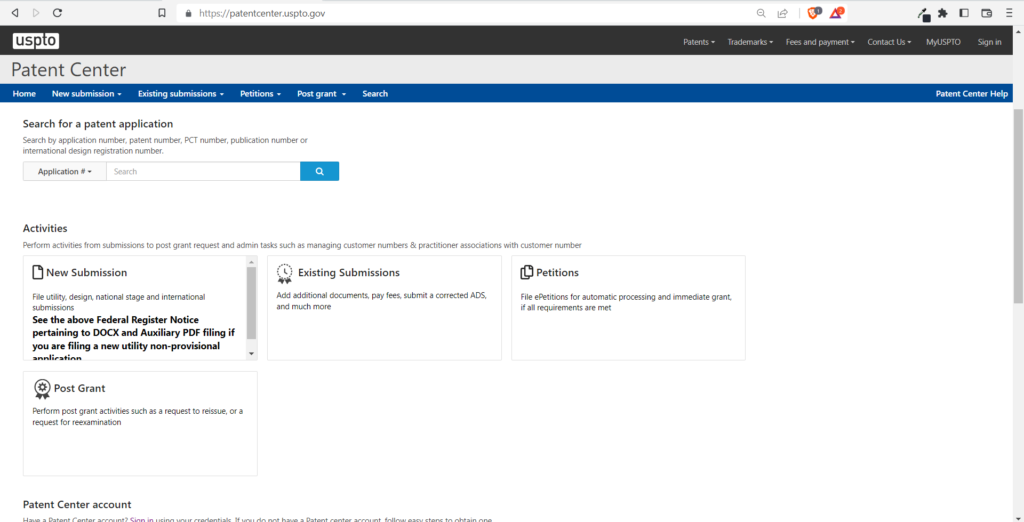
Figure 1: USPTO’s Patent Center Website
Step 2:
Select ‘Patent Number’ field (rather than the default selected, ‘Application Number’ – this is what one would used to look up a pending patent application number), from the drop down. Type ‘9305280’ in the ‘Search’ box and click the ‘SEARCH’ button. This corresponds with U.S. Patent No. 9,205,380 assigned to Amazon Technologies Inc. entitled, “Airborne fulfillment center utilizing unmanned aerial vehicles for item delivery”.
The next page will look like this:
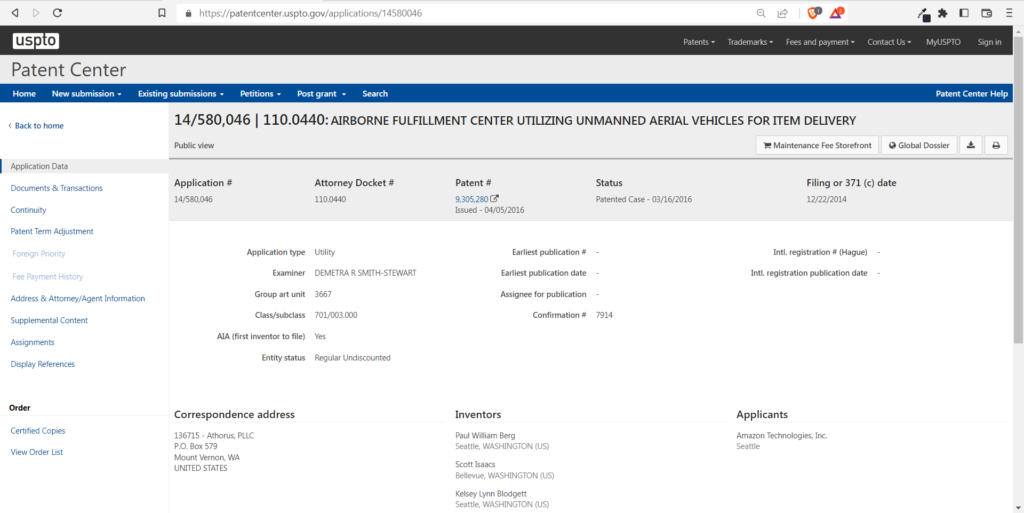
Figure 2. Patent Center, Application Data page for U.S. Patent No. 9,205,380
This page displays some of the key bibliographic information related to the patent. This includes data such as, ‘Inventors’, ‘Applicants’, and ‘Correspondence address’. One can find additional information here as well.
Step 3:
Next, click on the tab on the left side of the screen entitled ‘Documents & Transactions’. See the image below. The ‘Documents & Transactions’ tab is outlined in gray:
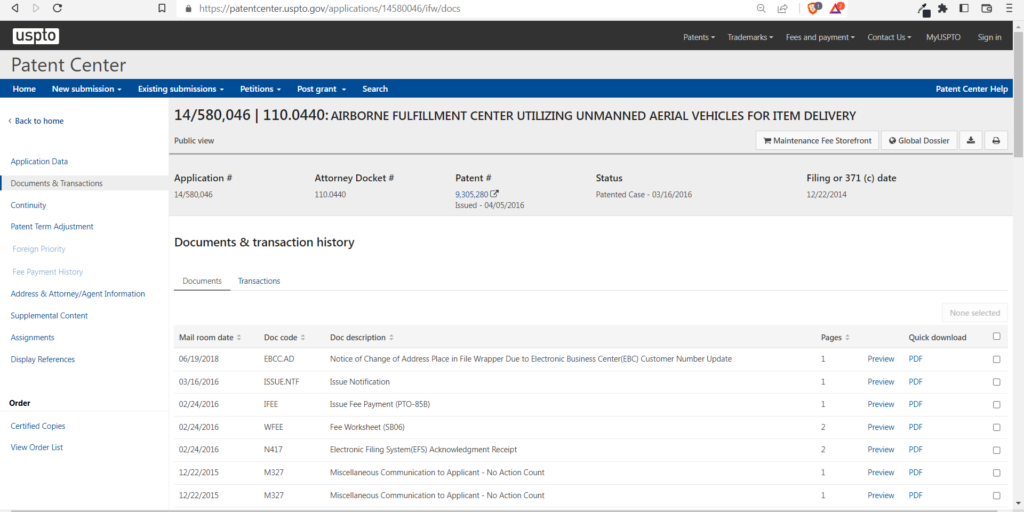
Figure 3. Patent Center, Documents & Transactions tab for U.S. Patent No. 9,205,380.
This tab displays the entire history of documents associated with this file wrapper. The most recent correspondence was from 06-19-2018 (at the top of the list) reflects a change in the applicant’s address highlighted.
Many of the documents available in the file wrapper can be downloaded by simply selecting the check box to the right of an item and clicking on the corresponding blue ‘PDF’ link associated with each document.
Step 4:
As one continues to review the file wrapper ledger, scroll down the page, one will see an entry from 04-01-2015 entitled ‘Non-Final Rejection’ (highlighted in blue). See Figure 4 below.
This is the entry in the ledger is an examiner’s non-final rejection document which provides details from the examiner of why he or she rejected the application.
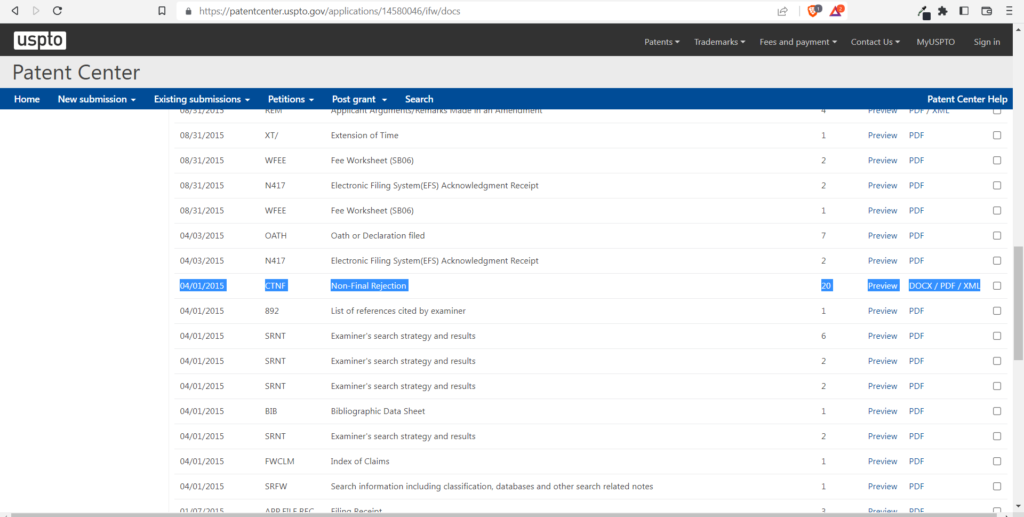
Figure 4. Patent Center, Application Data page for U.S. Patent No. 9,205,380, the File Wrapper Ledger- Non-Final Rejection.
The most common types of examiner rejections are described in U.S. Title Code 35 of the United States Code (35 U.S.C.), section 101 (unpatentable subject matter), section 102 (novelty – anticipation, citing of a single reference), section 103 (obviousness, citing of two or more references), and section 112 (errors in the written description such as indefiniteness – lack of claim language or unclear claim language in the written description). One can learn more about the different types of rejections here.
Step 5:
Click on the “Non-Final Rejection” blue hyperlink, a 20-page PDF document will open in the browser. This document contains details into the argument made by the examiner, Demetra Smith Stuart, as to why they issued a non-final rejection.
Scrolling to page three of the document (see Figure 5 below), highlighted in yellow below, that claims 1-13 and claims 15-20 were “rejected under 35 U.S.C. 102(a)(1) and 35 U.S.C 102(a)(2) as being anticipated by U.S. Published Patent No. 20140032034 to Raptopolous et al. hereafter, “Raptopolous”.
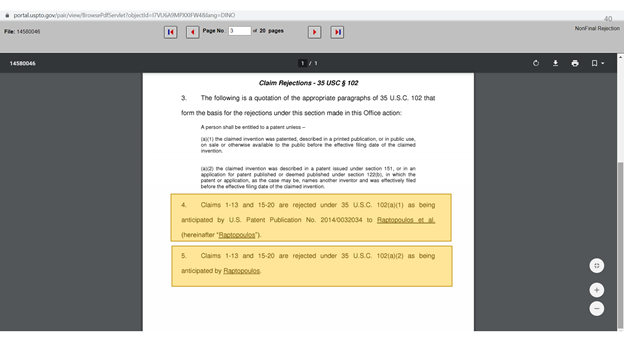
Figure 5. Patent Center, for U.S. Patent No. 9,205,380, Non-Final Rejection, Page 3.
The “Raptopoulos” published patent application was eventually allowed by an examiner and became U.S. Patent No. U.S. 9,384,668 (‘668) entitled, Transportation using network of unmanned aerial vehicles’. The patent appears to be assigned to Singularity University. Eventually this patent was likely licensed to MatterNet, a start-up founded by Raptopoulos in 2012.
By digging deeper into the ‘668 patent one would find additional insight into whether prior art was cited against it during its prosecution and if so what art, what arguments were made, etc. This is an iterative process that can feel overwhelming once one understands how much information is available to analyze. Conversely, it is very empowering to have access to so much information. Especially when making multi-million or billion-dollar investment decisions.
On another note, each examiner has a unique perspective, software developers and patent analysts have taken advantage of this publicly available file wrapper data to create profiles of each examiner. Patentbots.com enables one to drill deeper into examiner statistics around allowance, number of office actions, etc. See statistics for Demetra Smith Stuart here.
Step 6:
A deeper dive into the non-final rejection document reveals, for example on page 4, the specific arguments the examiner made, (see Figure 6).
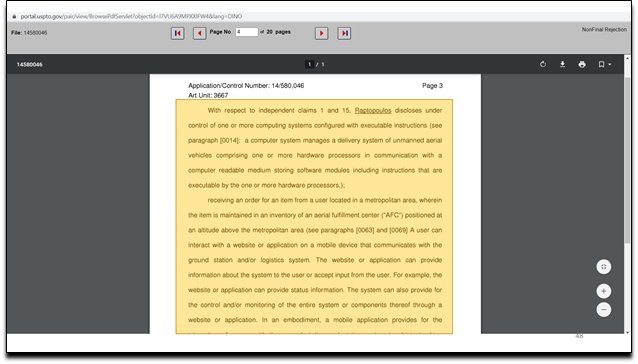
Figure 6. Patent Center, for U.S. Patent No. 9,205,380, Non-Final Rejection, Page 4.
Here is some of the text from the non-final rejection. The bold words are from the original filed claim from Amazon U.S. 9,305,280 (‘280) and the italicized words come from U.S. Patent Publication No. 20140032034 (Raptopoulos).
“With respect to independent claims 1 and 15, Raptpoulos discloses under control of one or more computing systems configured with executable instructions (see paragraph [0014]: a computer system manages a delivery system of unmanned aerial vehicles comprising one or more hardware processors in communication with a computer readable medium storing software modules including instructions that are executable by the one or more hardware processors,); receiving an order for an item from a user located in a metropolitan area, wherein the item is maintained in an inventory of an aerial fulfillment center (“AFC”) positioned at an altitude above the metropolitan area (see paragraphs [0063] and [0069] A user can interact with a website or application on a mobile device that communicates with the ground station and/or logistics system. The website or application can provide information about the system to the user or accept input from the user. For example, the website or application can provide status information. The system can also provide for the control and/or monitoring of the entire system or components thereof through a website or application. In an embodiment, a mobile application provides for the interaction of a user with the ground station or logistics system to obtain tracking information about a package. Such a mobile application can also allow the user to schedule a package drop off or locate a suitable ground station, for example, through identification of a current location or a desired location. The UAV can be designed to fly at altitudes of up to 10,000 feet, and be optimized to fly at lower altitudes, such as 1,000 feet. The UAVs can operate in segregated airspace, generally below an altitude of 400 ft and not near airports or helipads.);
The examiner arguments continue on for a couple more pages in the non-final rejection document and exemplify how each element of filed claims, 1 and 15 of the ‘280 patent application are present in the Raptopoulos reference. This is important as it details what limitations are in Raptopoulos, that Amazon is unable to claim as its own. Or, Stated another way, what elements can Raptopoulos control that Amazon can’t?
Here is a full copy of U.S. Patent No. 9,205,380’s Filewrapper – Also known as, Application No. 13776362
Step 7:
Going back to the file wrapper ledger, see an entry from 08-31-2015 which contains “Applicant Arguments/Remarks made in an Amendment” (highlighted in blue in the figure below).
This document contains the arguments made by the applicant in response to the examiner’s non-final rejection.
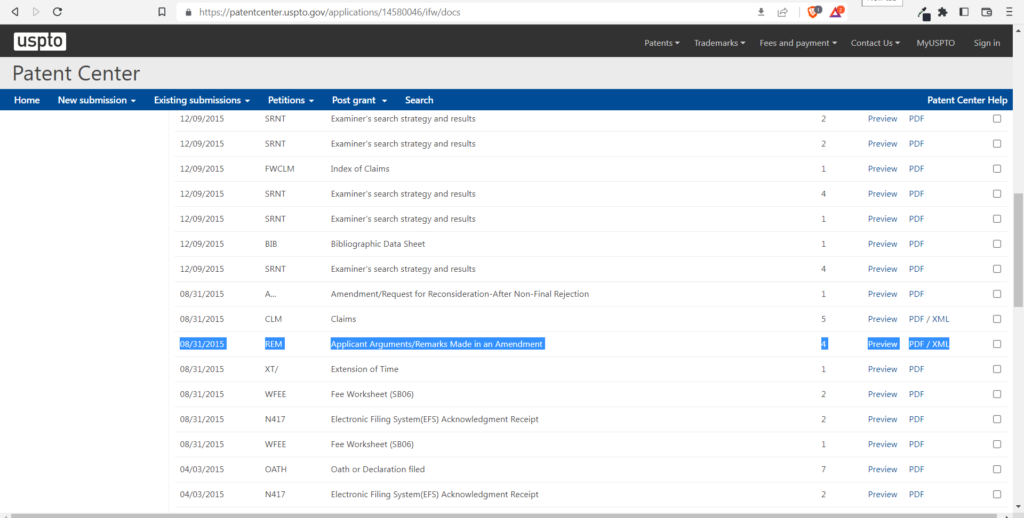
Figure 7. Patent Center, Application Data page for U.S. Patent No. 9,205,380, the File Wrapper Ledger- Applicant Arguments-Remarks made in an Amendment.
In this document (see Figure 9 below), one can see the “Summary of an Applicant-Initiated Interview”. The document states:
“During the interview, the reference, Raptopoulos, and the proposed amendments were discussed and agreement was reached that the proposed amendments to claims 1, 6, and 15 overcame the cited reference”.
Thus, through an interview, the applicant was able to overcome the examiner arguments. Although we don’t have the transcript of exactly what was said, we can access the amended claims later in the file wrapper.
This was clearly an interview proposed by the applicant in response to the examiner’s non-final rejection. Some patent attorneys/agents prefer to file broad claims with a patent application and then after receiving a non-final rejection from the examiner, they request an examiner interview. This strategy enables a savvy applicant to discuss the matter verbally without putting any of the details in writing (subsequently ending up in the file history). The filewrapper provides a written history of the back and forth of the patent application process. Including discussions related to patentability, prior art, and arguments of why or why not a patent should grant. This written material can create issues for an applicant in the future. Especially if the patent is the subject of a patent litigation.
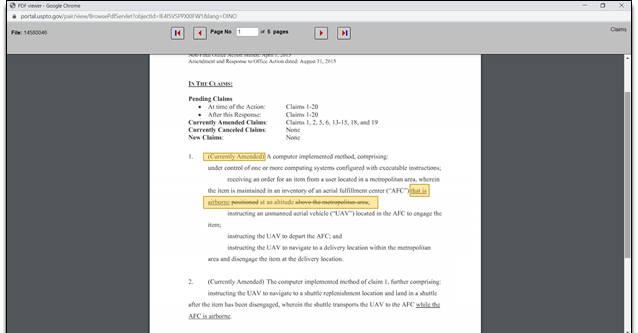
Figure 8. Patent Center, Application Data page for U.S. Patent No. 9,205,380, Amended Claim 1.
Step 8:
The screenshot below from the file wrapper displays the amended claims which were ultimately allowed. By simply removing a few words and adding a few others, the examiner was satisfied that the applicant traversed the cited prior art with respect to claim 1, see Figure 9 below.
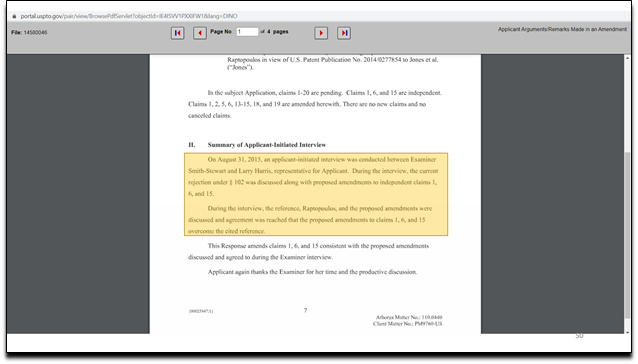
Figure 9. Patent Center, Application Data page for U.S. Patent No. 9,205,380, Summary of Applicant-Initiated Interview.
CONCLUSION:
This is a real-life, yet simplified example of how the examination process works between applicant and examiner. There are often several “office actions” that occur between the applicant and the patent examiner. A common sequence includes a non-final examiner rejection, an applicant amendment, a final rejection by the examiner, and then an applicant request for continued examination (RCE) is filed to continue the process.
All along, the file wrapper captures the communications between applicant and examiner. The underlying goal of the process is for the applicant to clarify the invention and exemplify how it is novel, non-obvious, and useful in light of the prior art.
Many times, patents are abandoned before they are allowed. This can occur for a variety of reasons including the possibility that there isn’t a patentable invention to allow, or in many cases, applicants become exhausted, or don’t believe it is worth continuing to spend money and time arguing with the patent examiner to get their invention issued.
An additional point to consider is the fact that examiners have a limited amount of time to search for prior art. Therefore, it is possible (and likely) that a patent issues in light of the prior art cited by the examiner, but additional published prior art exists that wasn’t discovered by the examiner that could ultimately “invalidate” a patent’s claims. In instances where patents are licensed or litigated, licensees and defendants are willing to scorch the earth to identify prior art that wasn’t cited in the file wrapper but was published prior to the patent application’s filing date. This enables accused infringers to invalidate the patent being asserted against them or potential licensees to avoid having to take a license.
In the end, the patent process is complex, and although reading a patent is essential to begin to understand the technology disclosed, it is critical to read the file wrapper to get the full picture of how the technology is unique in the context of other innovations. While patent attorneys and other patent experts use file wrappers as a tool to understand the specific ‘legal’ limitations of the patented technology in light of the prior art; non-patent experts can derive important technical clues as to a technology’s unique (or not so unique) features which can impact business and/or R&D strategy. Reading file wrappers offers insight into how the boundaries of a patent’s claims are shaped and what elements of a technology its owner can control.
Understanding these issues is critical for enterprises. The benefits of this information intersects with a variety of disciplines. Engineers, scientists, business executives, marketers and patent attorneys benefit from studying the publicly available information contained in a patent’s file wrapper not only for intellectual property decision making, but also to drive decisions related to R&D initiatives, licensing, M&A and other corporate strategies.
EPILOGUE: ADDITIONAL INFORMATION RELATED TO PATENT FILE WRAPPERS
Here are some additional points to consider regarding file wrappers:
- Patent applications can be filed and prosecuted by:
- Inventors that represent themselves during the patent prosecution process.
- Patent agents that represent the applicant(s).
- Patent attorneys that represent the applicant(s).
- Patent examiners must have technical expertise, and they must go through rigorous training to become a patent examiner. However, patent examiners do not have to be attorneys or patent agents in order to be a patent examiner. This is interesting and also obviates the importance of technical experts reviewing patent applications and file wrapper.
- Patent examiner’s work is guided by an Examination Time and Production system. Examiners work on an incentive a points system. Each task results in a different number of points which are aimed at producing an efficient patent examination corps.
- The current backlog of unexamined patent applications is over 625,000. Additional statistics including traditional pendency time, time to first office action and other data can be found at the USPTO dashboard for patents.
- Examiner/Applicant interviews are often conducted and although notes from those telephone or (pre-COVID) in-person interviews are sometimes uploaded to the file wrapper, audio or video recordings of those conversations are not included in the file wrapper.
- The information found in the file wrapper is often discussed when during patent litigation. The file wrapper provides a written history of the patent application process which can last several years or more detailing the process of getting a patent issued. Legal counsel from both sides (plaintiff and defendant) uses the back-and-forth discussion between applicant and examiner as a resource to confer or refute aspects of the technology. This sometimes occurs years after those discussions in the file wrapper took place. Savvy patent drafters and prosecutors understand this and often let it be a guide to how they respond to or do not respond to office actions and other examiner correspondence.
The post PATENT ANALYSIS 2023: PATENT FILE WRAPPERS AS A TOOL FOR COMPETITIVE INTELLIGENCE appeared first on IP Checkups | Patent Categorization Software.
]]>The post Devices Powered by Sound – The Next Big Mobile Device Innovation appeared first on IP Checkups | Patent Categorization Software.
]]>As consumers anxiously await the release of Apple’s iPhone 6, innovators in the battery industry continue to develop new technologies for the next generation of smartphones. Two teams of scientists, from Nokia and Queen Mary University of London (QMUL), are working collaboratively to develop an energy-harvesting prototype that could charge mobile phones using sounds such as everyday background noise.
How is this possible? According to Nokia, the answer is through nanotechnology and zinc oxide. Crystalline zinc oxide is a piezoelectric material that converts mechanical energy into electrical energy. Scientists from the Nokia/QMUL team transformed zinc oxide into nanorods, suitable to coat almost any surface. When condensed or stretched, these nanorods generate high voltage. To produce a strong enough charge for a mobile device, electrical contacts are placed on both sides of the rods, which transform sound vibrations into energy and capture the charge.
While Nokia and Queen Mary University of London have been experimenting with zinc oxide, so have many others. According to our database, more than 100 zinc oxide battery patents have published in the U.S. in the last two months alone. A quick search for “zinc oxide” and “harvesting energy” revealed more than a dozen patent applications published within the last year focused on energy harvesting and mobile device charging methods.

Image Credit: Nokia
After a brief search in the ABC PatentEdge, IP Checkups did not find a published patent application associated with this innovation assigned to Nokia and/or Queen Mary University of London. Our search did reveal European patent number EP2008317A1, “A METHOD AND APPARATUS FOR HARVESTING ENERGY FROM MECHANICAL VIBRATIONS”, assigned to Commonwealth Scientific and Industrial Research Organisation (CSIRO); however, this patent focuses primarily on electronics, not materials.
Will this experiment of using sound to create energy succeed in time for the next big Microsoft/Nokia phone release? Or will another company beat them to it? Follow ABC PatentEdge for the latest news and innovations in the battery industry.
The post Devices Powered by Sound – The Next Big Mobile Device Innovation appeared first on IP Checkups | Patent Categorization Software.
]]>The post State of Battery IP: Top Companies in Separators appeared first on IP Checkups | Patent Categorization Software.
]]>
More than 400 U.S. patent applications related to separators published between July 1, 2013 – June 30, 2014. Olefins and plastics were the primary focus of these companies’ innovation, though LG Chem also appears to have a strong interest in cellulosic separators. LG Chem was the clear leader in separator patenting.
Below is a handful of patents that were added to LG Chem’s portfolio last year. For complete access to all separator-related patents, subscribe to the ABC PatentEdge database.

Have questions? Contact us at info@ipcheckups.com. We’re here to help!
The post State of Battery IP: Top Companies in Separators appeared first on IP Checkups | Patent Categorization Software.
]]>The post State of Battery IP: Top Companies in Electrodes appeared first on IP Checkups | Patent Categorization Software.
]]>Top Companies: Electrodes
More than 1500 U.S. patent applications related to electrodes published between July 1, 2013 – June 30, 2014. Within the past year, Samsung and LG Chem have been battling it out for the title of most prolific patent filer in the Lithium and Nickel areas.
Below is a short list of patents from Samsung and LG Chem. For complete access to all electrode-related patents, subscribe to the ABC PatentEdge database.

Have questions? Contact us at info@ipcheckups.com. We’re here to help!
The post State of Battery IP: Top Companies in Electrodes appeared first on IP Checkups | Patent Categorization Software.
]]>The post Stretchable Batteries appeared first on IP Checkups | Patent Categorization Software.
]]>Director of Research, Analytics, and Business Development
Wearable electronics have been ballyhooed by many as the next truly revolutionary “smart technology.” Integrated into clothing, accessories, and other personal devices, these networks of sensors linked to tiny portable computers are uniquely positioned to harvest next-generation health and behavioral data from their human hosts.
Unlike smart phones, which may be casually relegated to desks and charging stations while their users sit at home or work, wearable electronics continuously monitor consumers’ activities, heart rates, and emotions, for the entire duration of their use. Doctors and medical researchers believe that this data could vastly improve patient outcomes, and marketing professionals are practically salivating at the wealth of behavioral information that may be used for increasingly individualized advertising campaigns.
Currently limited to an array of relatively clunky—yet increasingly stylish—devices, the future of wearable electronics may ultimately depend on groundbreaking research in battery technology. Apparel-based devices, for example, should optimally stretch and bend with their users, but although printed circuit technology offers some solutions for sensor and computing components, suitable batteries remain a significant challenge.
Many researchers have achieved a high degree of flexibility in their batteries, but stretchable cells are still largely the stuff of the future. It is difficult to maintain sufficient cell density while simultaneously creating a high degree of elasticity in the battery itself. Collaborative research from the University of Ilinois at Urbana-Champaign and Northwestern University has yielded encouraging results, and promising developments have also been reported by groups at Stanford and CUNY.
Using its advanced battery research database, the ABC PatentEdge™, IP Checkups also identified a handful of other organizations that appear to have focused research efforts on stretchable batteries. As is common with early stage technologies, universities and other public research institutes feature prominently in the space; however, some private companies—large and small—have also invested resources in this area.


Table 2. Patenting activity by top organizations. The number of patents filed by each group, in each calendar year, is shown in the table below.
In addition to identifying organizations with interest in stretchable batteries, the ABC PatentEdge also offered some insight into the aspects of stretchable battery technology on which these groups primarily focus. Polymer-based separators are the most common area of interest, and over 50% of patents relating to stretchable batteries discuss at least one innovation in separator or electrolyte technology.

Table 3. Technologies of primary interest in stretchable battery patents, as determined from ABC PatentEdge data.
More information regarding top innovators and new developments in stretchable battery technology and other battery-related innovations can be found in the ABC PatentEdge. Monthly and quarterly summaries of this information are also available by subscription at www.abcpatentedge.com
The post Stretchable Batteries appeared first on IP Checkups | Patent Categorization Software.
]]>The post IP Checkups’ Advanced Battery Partners appeared first on IP Checkups | Patent Categorization Software.
]]>IP Checkups developed the ABC PatentEdge™ with input from experienced battery technology experts, representing eight key member organizations of the National Alliance for Advanced Technology Batteries (“NAATBatt”). NATTBatt is a not for profit trade organization of foreign and domestic corporations, associations and research institutions focused on the manufacture of large format advanced batteries for use in transportation and large scale energy storage applications in the United States. Members include advanced battery and electrode manufacturers, materials suppliers, vehicle makers, electric utilities, equipment vendors, service providers, universities and national laboratories. NAATBatt’s core missions are to grow the North American market for products incorporating advanced energy storage technology and reduce the cost of those products to U.S. consumers.
Over the past several quarters, IP Checkups has been delivering exclusive ABC PatentEdge quarterly updates to NAATBatt member companies.
“NAATBatt is excited to be partnered with IP Checkups. We believe the ABC PatentEdge provides advanced battery and capacitor companies, investors, and research institutions with critical insight into emerging technologies, trends, and opportunities in advanced energy storage markets,” said James Greenberger, Executive Director, National Alliance for Advanced Technology Batteries.
IP Checkups has also developed a strong partnership with CalCharge, a groundbreaking public-private partnership working to accelerate the development, commercialization, and adoption of new energy storage technologies for the consumer, transportation, and grid markets. On Tuesday, July 22, IP Checkups is hosting an introductory webinar on the Advanced Battery & Capacitor PatentEdge at 12 PM PST for CalCharge members. If you are a Calcharge member or would like to find out more about the webinar or becoming a CalCharge member, please contact Chris Mohajer for access to the webinar.
By establishing strong partnerships with trailblazing organizations such as NAATBatt and CalCharge, IP Checkups is proud to support and accelerate innovation in the green technology space. The ABC PatentEdge is critical to providing innovative battery and capacitor companies with access to important insights into technology ownership and technology development information so they can continue to focus on creating novel and innovative technologies.
The post IP Checkups’ Advanced Battery Partners appeared first on IP Checkups | Patent Categorization Software.
]]>